



View Information About HSR Ratings
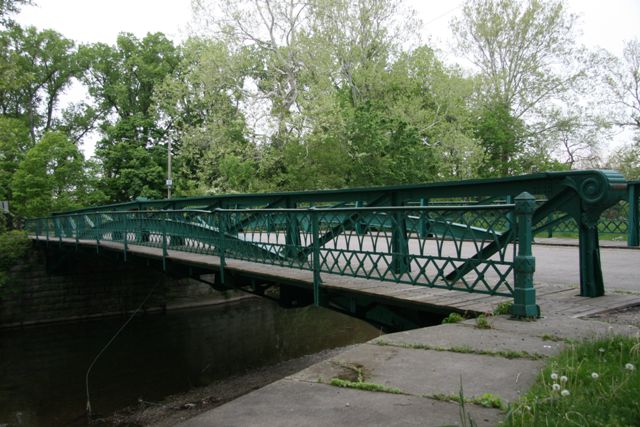
This stunning bridge is unlike any other encountered. Its unusual design combined with significant aesthetic elements form a bridge that has a somewhat European look to it.
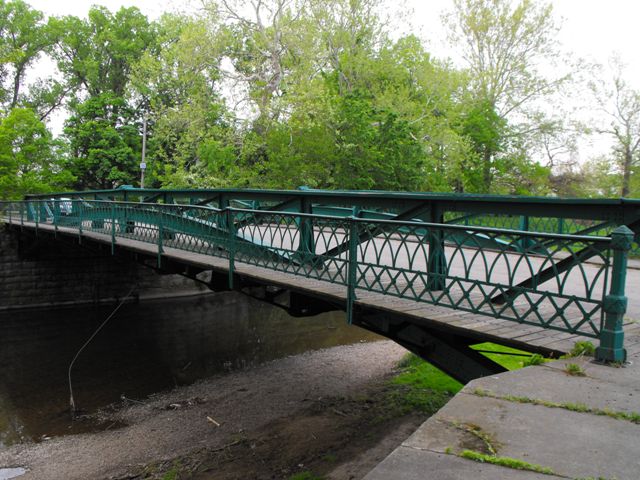
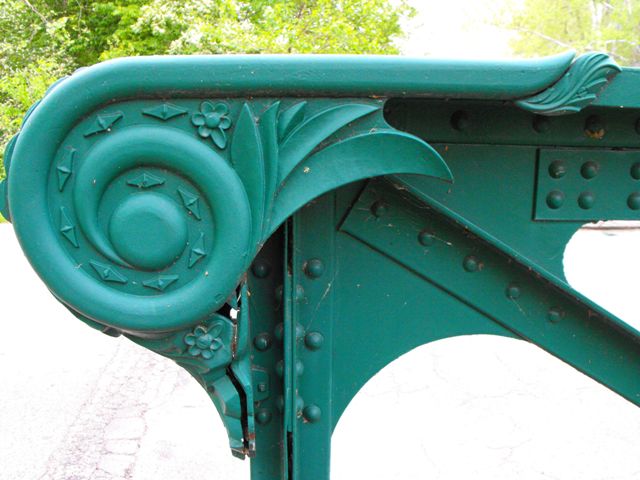
The bridge is highly unusual from a design standpoint. The arch is technically a through arch, but the arch only rises above the roadway a short distance. Much of the arch is below the deck. The shallow arch is further masked by the unusual method in which the arch has been trussed. Typical trussed arches have truss work which follows the shape of the arch. However in this case, the truss is variable depth with a consistently horizontal top chord such that the bridge looks much like a simple pony truss rather than an arch bridge. The end posts of these trusses have beautiful decorative castings that attach onto them. These castings are complimented by smaller castings located on the truss at the center of the span.
The unusual design of this bridge gives it a high level of technological significance, and the extremely high level of aesthetic treatment also add to the historic significance of the bridge. The Historic Bridge Inventory is right on target in its assigning the bridge a high level of significance.
Railing Design on The Bridge: A Mystery

The aesthetic value of the bridge is also greatly increased by the pedestrian railing on the bridge. The sidewalk railing follows a general pattern which HistoricBridges.org has defined the "Arch Lattice Railing" and is one of the most beautiful designs of railing to be encountered. The exact proportions and details vary, but this railing design consists of the overlapping curved bars on the upper portion of the railing panel and a traditional lattice pattern occupying the smaller lower section of the railing panel. This distinctive design does not appear to have an association with any particular builder, and it is rare to encounter, but can be found scattered throughout the United States. In the case of the Snyder Memorial Bridge, these railings terminate in ornate cast end posts. A search of old magazines found a company in Pittsburgh which advertised this general railing design in its ad. Run by and named after Chester B. Albree, an obituary commented that his decorative railings could be found across the county. Read the obituary and also see some of the interesting patents that Albree held by reading this PDF file. It is not known if this company might have been responsible for the general "Arch Lattice Railing" theme, or whether or not they might have provided railings for this bridge at Snyder Park. The reality is, the railings that follow this design vary so much in the smaller details that it seems unlikely that a single company was responsible for the design. However one company, like Albree, may have "invented" the general design.

Information and Findings From Ohio's Historic Bridge InventorySetting/Context The bridge carries a park road and sidewalks over a stream in Snyder Park in Springfield. The road provides access to a golf course and recreational fields to the north. South of the bridge is a casually landscape parkway with picnic pavilion, lawns, a pond, and mature trees. The 217-acre park was established in the late 19th century by John and David L. Snyder as a gift to the City of Springfield. They endowed the park with a $200,000 bond for its upkeep and paid $25,000 for the construction of the memorial bridge. Physical Description The bridge carries a park road and sidewalks over a stream in Snyder Park in Springfield. The road provides access to a golf course and recreational fields to the north. South of the bridge is a casually landscape parkway with picnic pavilion, lawns, a pond, and mature trees. The 217-acre park was established in the late 19th century by John and David L. Snyder as a gift to the City of Springfield. They endowed the park with a $200,000 bond for its upkeep and paid $25,000 for the construction of the memorial bridge. Integrity Rehabilitated in 1995 with ISTEA funding. Most diagonals appear to have been replaced with welded members. The upper chord and verticals have been strengthened in numerous locations with the addition of welded plate. There is impact damage at the end posts and one panel of the upper chord has warped/buckled. An extra set of lower lateral crossbracing has been added in some panels. Summary of Significance The 1897 Snyder Park arch bridge was rehabilitated in 1995 with replacement of the deck and strengthening of numerous of its members with the addition of welded plate or replacement with welded members. Three-hinge metal arches came into use in the last quarter of the 19th century, and this is the oldest inventoried example of four dating from 1897 to 1958 (Phase 1A, 2008). Hinged steel arches are usually identified with longer span bridges where a monumental bridge was desirable (e.g., Detroit-Superior Bridge, SFN 1800093). This is a relatively modest example in terms of length. It is an aesthetic bridge in keeping with the park setting. It was advanced from the reserve pool to eligible in 2000. The eligible recommendation of the prior inventory remains appropriate. Justification The bridge is one of the five extant examples of the type that was used for a variety of crossing types, from major, monumental bridges like the 1917 Detroit-Superior Viaduct in Cleveland to the 1952 Gordon Park Pedestrian bridge over the Memorial Shoreway. The bridge has a high level of significance based on its age and the rarity of the design. Bridge Considered Historic By Survey: Yes View PDF Historic Bridge Inventory Sheet
|
This bridge is tagged with the following special condition(s): Arch Lattice Railing


Coordinates (Latitude, Longitude):
Search For Additional Bridge Listings:
Bridgehunter.com: View listed bridges within 0.5 miles (0.8 kilometers) of this bridge.
Bridgehunter.com: View listed bridges within 10 miles (16 kilometers) of this bridge.
Additional Maps:
Google Streetview (If Available)
GeoHack (Additional Links and Coordinates)
Apple Maps (Via DuckDuckGo Search)
Apple Maps (Apple devices only)
Android: Open Location In Your Map or GPS App
Flickr Gallery (Find Nearby Photos)
Wikimedia Commons (Find Nearby Photos)
Directions Via Sygic For Android
Directions Via Sygic For iOS and Android Dolphin Browser
USGS National Map (United States Only)
Historical USGS Topo Maps (United States Only)
Historic Aerials (United States Only)
CalTopo Maps (United States Only)

© Copyright 2003-2024, HistoricBridges.org. All Rights Reserved. Disclaimer: HistoricBridges.org is a volunteer group of private citizens. HistoricBridges.org is NOT a government agency, does not represent or work with any governmental agencies, nor is it in any way associated with any government agency or any non-profit organization. While we strive for accuracy in our factual content, HistoricBridges.org offers no guarantee of accuracy. Information is provided "as is" without warranty of any kind, either expressed or implied. Information could include technical inaccuracies or errors of omission. Opinions and commentary are the opinions of the respective HistoricBridges.org member who made them and do not necessarily represent the views of anyone else, including any outside photographers whose images may appear on the page in which the commentary appears. HistoricBridges.org does not bear any responsibility for any consequences resulting from the use of this or any other HistoricBridges.org information. Owners and users of bridges have the responsibility of correctly following all applicable laws, rules, and regulations, regardless of any HistoricBridges.org information.


