The Capilano Bridge, Marine Drive,
West Vancouver, BC

Copyrighted Information: Reproduction with Author’s Written Permission Only
The Capilano Bridge, Marine Drive,
West Vancouver, BC
Additional Information
A. Historical Significance
The Capilano road bridge over the Capilano River at Marine Drive was the second of two local Bridges to provide access across the river. The Earliest Bridge was the Keith road timber trestle,
located near the current day Upper Levels Highway crossing built in 1898.
The Capilano Bridge consists of a series of attempts, the first bridge of which was built in 1914, and completed in March of 1915. The official opening of the bridge was held on August 10, 1915, where, Premier (Sir) Richard McBride officially opened the concrete bridge. Using a “silver key” he unlocked a special gate and the drove in a car over the bridge to Cypress Park where he
made a speech. The first bridge was built by the Naylor brothers (Engineers and Contractors, est. 1837) of England, where in a letter addressed to the “Reeve and Council of West Vancouver” on February 28th, 1914, declared that:
• The many advantages of our design over the wooden structure [proposed by others and being considered at the time] are in brief as follows:
- o We can give you a permanent fixture not affected by the Storm, or Toredo, for a sum within the Bye-Law,
- o We will deposit a satisfactory Surety bond to guarantee the design and maintenance for one year after completion,
- o We will give you all the advantages comprised in your wooden design,
- o Our drawings are a monolithic ridged mass which will resist external forces more readily than others, as well as last for over a hundred years,
- o Our concrete pile are anchored into the rock from 3 to 5 feet and concreted in position, preventing any chance of moving,
- o Our designs are accepted by the Dominion Govt, Marine and Fisheries Dept, as the highest type of wharf that can be built.
Figure A3: Pedestrians Using The First
o Figure A4: Opening Day of First Bridge, 1915
The first bridge was opened with great fanfare and cost $50,000 to build, and included beautifully detailed slender concrete arch beams and railings featuring Union Jack Motifs, with electric glass strobes to light the bridge at night. Before dignitaries deemed it safe for traffic, a load test comprised of 61,000 lbs of timber was placed on the bridge for 24 hours on March 3, 1915.
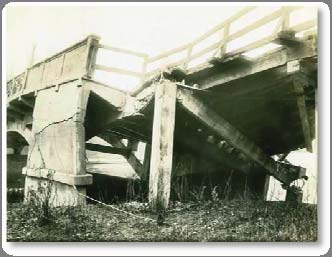
Just one year after opening, and following the result of a notorious flash flood of the Capilano River in December 1916, the new bridge’s piers were severely damaged and caused a partial collapse of the deck in one area.


At one point on July 2, 1919, an article appeared in the West Vancouver Courier discussing the need to transport 13 tons into the city, and how the city council tried to talk their way through the capacity of the bridge:
- Councillors had apparently backtracked on an earlier motion to raise the load limit to double the limit, but were unable to do so due to a by-law limitation, and that,
- If the load was only going over by a ton or two of the load rating, he would not say anything.
- The council then declared that the corporation (WV) was safeguarded if the bridge did not go down for a load under 5000 lb, and added that if the bridge could safely carry a load of 13 tons, then 5000 lbs should be perfectly safe.
- The councillor then asked Coun. Thompson to revise the municipal traffic by law which apparently was considerably out of date, but that residents were working under a hardship and that it was he should make the terms as favourable as possible.
Both North Vancouver and West Vancouver shared in ongoing costs to repair the bridge to keep it open for development and movement of timber resources.
Subsequent floods added to ongoing damage, and then in 1921, the bridge was virtually destroyed by flooding. For many years since the original flood, local residents Figure A6: Major Pier Damage to Original reportedly did not trust the bridge’s capacity and continued to use Bridge, 1916 the original, but condemned, Keith Road timber truss. The Keith road bridge was later washed out and destroyed in 1917 following a similar flooding torrent.
A letter by W.V City council on January 3rd, 1918 to the Minister of Public Works, expressed “regret that the Eastern Abutment of the bridge had been undermined and had collapsed due to the extra heavy rise of the river on the 31st [December]. Furthermore, that the District is now entirely cut off from North Vancouver by road, and is dependent on our small ferry boats, which are unable to satisfactorily handle freight traffic. The Marine Drive and bridges have cost the district some $250,000 and under present circumstances, it would be extremely difficult to raise funds for the necessary repairs, I trust that your department may be able to come to our assistance in the matter, which is very urgent”.
The Minister of Public works came to the Municipality’s rescue and helped by funding a new bridge that was built and opened in 1930. The second Capilano Bridge was a steel Truss that was opened on May 3, 1930 by Premier Tolmie BC and his Wife. The official opening and exquisite luncheon that was held at the Cliff House (Whytecliff Park) was originally postponed due to Premier Tolmie’s inability to attend due to scheduling issues. A letter from the WV Mayor’s office to the Premier’s office following the original rejection stated that having the Premier’s attendance with his wife was most important to the bridge opening ceremony, and that, the earliest possible date would be arranged such that the Premier and his Wife Could make it. Quoted as saying that “this [opening of new steel bridge] is the most important event that has taken place in years on the North Shore, and in view of the nearly $1M spent on the Marine Drive highway, much in part due to the Ministry, felt it would be highly important that the Premier attend this milestone event”.



Over 150 Attended the luncheon, and included such dignitaries such as The Honorable T.D. Pattullo, Mayor Morden and Mayor Wells Gray, Past and present City councellors, Patrick Philip- deputy Minister of Public Works, MLAs, Lieut-Col’s W.W.Foster (Mountaineering Club) and Nelson Spencer (MLA), reporters for the North Shore News, Evening Sun, Morning Star, and other editors (Journal of Commerce, BC Municipal News), various prominent members of local associations such as
Figure A9: Completed Steel Bridge Span, 1929
the president of the 2nd Narrows Bridge, president of the Gleneagles golf course (Gen. Clark), bank members, presidents of the Rotary, Kiwanis, Gyro, and Lion’s Clubs, as well as other members of the community. An exquisite menu consisting of “Clear soup in cans, olives, and Fancy Cakes” was served.
A speech by Premier Tolmie included the following highlights:
- •
- The problem of providing permanent access to the municipality of West Vancouver across the Historic Capilano river has at last been solved, but not without a series of difficulties and vicissitudes.
- •
- Unfortunately the original bridge proved unsuitable for such a turbulent river and was destroyed in 1921, leaving only one pier intact,
- Using this single pier as a base, a temporary wooden erection was thrown across the river, which by an ingenious system of wing dams was brought under partial control, compelling the main current to carve out its own channel,
- A more solid structure was essential to meet increasing demands of motor traffic, and extraordinary development seen in the municipality,
- In 1929, the Provincial Gov’t realizing the seriousness of the situation, offered assistance to the Municipality, which is the result of this new Bridge.
- The artistic design is by Mr. A.L. Carruthers (M.E.I.C.), the Provincial Bridge Engineer, and the work completed under the capable supervision of Mr. Patrick Phillip, Deputy Min. Public Works.
- The Structure is of Steel having a 250ft span making it the longest in the Province, with concrete road-way and side-walks, and fine approaches from the main Drive.
- The Capilano bridge, costing $150,000 not only typifies the skill and ability of its builders, but also forms an important link one one of the finest scenic highways in the Province, extending from Capilano to Whytecliff, and opening up a residential area unsurpassed for Natural beauty on the Pacific Coast.
An impressive Souvenir Album of West Vancouver was created and handed out to guests of the opening. The Foreword of the Album states:
• The New Bridge which spans the Capilano River over Marine Drive was officially opened for traffic by the Hon. S.F. Tolmie, Premier of BC on May 3rd, 1930. This Event marked another milestone in the history and development of the municipality.


• Visitors will find in W. Vancouver their ideal home sites on picturesque beaches or among dark fir trees on the mountain side, or in romantic sylvan glens beside hurrying streams, and will add by their enthusiastic praise to West Vancouver’s fame for scenic charm and beauty.
The second bridge served until November 1949 when a catastrophic rising of the Capilano River again plagued the crossing’s structures. On December 2, 1949, the Vancouver Daily Province newspaper showed an excellent aerial photo of the damaged river mouth area which washed out the Western Approach to the bridge, leaving it cut off from the mainland, and The Vancouver Daily Province placed a front page image of the situation on December 5th, 1949. Amazingly, this steel bridge and its piers withstood the flooding of the river which has reportedly had risen 6 ft over one night.
On December 1st, 1949, Premier Johnson declared the North Shore a state of emergency due to the bridge link wash-out, and the Royal Canadian Engineers were promptly called in to bridge the gap with a temporary bailey bridge until the second steel span was successfully completed.
An article appears in the Vancouver Sun on December 1, 1949 that was titled” West Vancouver bridge Washed Out 2nd Time, Army Called out, Capilano rose 64” from last night to noon today!”.
An interesting local’s story was that Mrs. Sharp, who had gone into labour with her 4th child had walked carefully over the ‘Pipe-line’ bridge further up the Capilano river canyon to an awaiting Ambulance that later sped her to a hospital in North Vancouver where she gave Figure A13: Ariel View Of 1949 Washout
birth (by G. Stilson).
In August (27) of 1955, the original bronze tablet that commemorated the opening of the first bridge was unearthed by local workmen. The inscription showed the names of the 1914 ‘Reeve’, and the name of the contractors (Naylor Bros. Of Huddersfield, England).


B. Engineering Significance
The 77m (250 ft) single span Pennsylvania Through-Truss was noted in Premier Tolmie’s speech at the opening day reception of this second bridge in 1929 as being the longest in the Province when it was constructed in 1929. Realizing the seriousness of the economically disabling situation afforded by complete wash out of the first concrete bridge over the Capilano River and years of unreliable
and unsafe passage for the public and years of requests for assistance by the Municipality, the Provincial Government’s primary task in financially supporting a new second bridge was to ensure that a more solid and permanent structure would be designed and constructed over the Capilano River.
The problem of providing permanent access to the Municipality of West Vancouver across the historic Capilano river had, with the completion of the new truss
bridge, “at last been solved, but not without prior difficulties and trials of previous attempts” as noted by the
Premier during his speech. The premier went on to note that the primary weakness of the original concrete crossing which caused major structural damage and premature failure of the deck was the insufficient embedment of the supporting concrete foundations which were excavated and built by hand.
Survival of the original steel truss span superstructure and supporting pier foundations when the adjacent earth approaches were dramatically gouged and washed out in 1949 was verifiable evidence that the most recent structure
had met its design intent and stood up to extreme natural forces caused by the flash flooding of the Capilano River, impressive forces that it had been engineered to resist. Major flooding with torrential flash floods causing extreme hydraulic action were annual occurrences at the bridge’s location until the Capilano River was dammed by the Cleveland Dam in 1954, relieving future engineering demands on potential new structures that may be intended to traverse the River.
The original concrete bridge’s very premature destruction
only one year after it was opened following construction for use by the public is an engineering lesson worth noting in itself: Perhaps an underlying circumstance that has helped shape the most current engineering code of ethics. An original petition and letter to the Municipality of West Vancouver by the English Engineering firm who claimed that their concrete structure would be the strongest possible solution to the previously considered timber option and would last for 100 years due to the very strong piers embedded deep into the river floor. However, lack of local design knowledge of the true power of the Capilano River combined with relaxed, non-conforming construction practices possibly due to lack of engineering oversight, seem to be the culprits that contributed to an inferior structure that could not resist the powerful river forces, or withstand the local river’s hydraulic loads and forces imparted upon it by the river.


| Ironically, the original bridge had been successfully load tested | Figure B4: Load Testing Of First Bridge |
|---|---|
| for 24 hours by 61,000 lbs of timber over an area of 209 square | |
| feet, or 292 psf which is equivalent to a metric loading of 14.10 | |
| kPa: a loading that is relatively comparable to the 16 kPa Traffic | |
| surcharging loading used by Geotechnical engineers in assessing | |
| retaining walls and abutments for global stability, and | |
| approximately half the load of a CL-625 (=140,000) Truck used | |
| for design of today’s current bridges. Although a respectable | |
| loading to apply as a test to the original bridge for the | |
| magnitude of the truck of the day in order to convince the | |
| Municipality that the structure had the design capacity as | |
| promised, the real test become that of the lateral loads | |
| imparted by hydraulic loading on the piers, a condition that | Figure B5: First Bridge Deck Constructio1914 n, |
| proved too much for the structure one year after it was | |
| officially opened. The intrinsic historical lesson resulting from a | |
| situation that had the Municipality convinced they had | |
| received a robust structure clearly demonstrates how much | |
| influence and integrity the engineer and contractors have in | |
| their communications with public decision making authorities , | |
| and how such life experiences helped politically shape and | |
| delineate the stringent design criteria required for the Steel | |
| Truss bridge, thus significantly contributing to the permanent | |
| solution that it has become and met successfully, | Figure B6: First bridge Construction, 1914 |
| demonstrating by example the capabilities of engineers of the |
day to recognize the problem to solve and present a robust solution that encompassed all of the invested criteria invested, a strict budget, and upheld the political reputation of the Premier, the Municipality’s Mayor and council staff, to provide a link that would help serve and shape the region into what it is today.

