



View Information About HSR Ratings
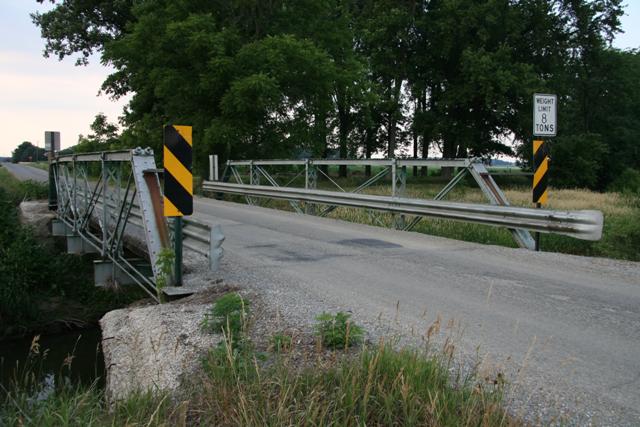
This four panel structure was likely built by the Wrought Iron Bridge Company, because it features the unusual threaded rod with nut detail at the end posts that act as connections for the bottom chord and diagonal members. In addition, the overall style (latticed vertical members, etc) is similar to other bridges that are officially documented with the company.
This bridge is similar to the nearby 245 bridge.
Information and Findings From Ohio's Historic Bridge InventorySetting/Context The bridge carries a 2 lane road over a stream in a rural area of active farms. Physical Description The 1 span, 45'-long, pin-connected Pratt thru truss bridge is traditionally composed of built-up compression members and eyebar tension members. It has the cast connecting pieces at the end posts typical of Wrought Iron Bridge Co. truss bridges. Integrity Railings replaced. Summary of Significance The ca. 1880 Pratt pony truss is technologically significant. The design, with its distinctive upper chord panel point connection details, is characteristic of Wrought Iron Bridge Co. (WIBCo) Pratt pony trusses
dating from the mid 1870s to early 1890s. The design is described as "very popular" and having been built widely in an 1881 WIBCo catalogue. It is 1 of at least 13 very similar examples dating from 1874 to the early 1890s. Justification The bridge is one of over 150 extant pin-connected truss bridges dating from 1874 for pony trusses and 1876 for thru trusses. Twenty six predate 1888 and represent the era of experimentation that evolved into standardized designs by about 1888. This example has moderate significance because the genre and the fabricator are so well represented in Ohio. Bridge Considered Historic By Survey: Yes |


Coordinates (Latitude, Longitude):
Search For Additional Bridge Listings:
Bridgehunter.com: View listed bridges within 0.5 miles (0.8 kilometers) of this bridge.
Bridgehunter.com: View listed bridges within 10 miles (16 kilometers) of this bridge.
Additional Maps:
Google Streetview (If Available)
GeoHack (Additional Links and Coordinates)
Apple Maps (Via DuckDuckGo Search)
Apple Maps (Apple devices only)
Android: Open Location In Your Map or GPS App
Flickr Gallery (Find Nearby Photos)
Wikimedia Commons (Find Nearby Photos)
Directions Via Sygic For Android
Directions Via Sygic For iOS and Android Dolphin Browser
USGS National Map (United States Only)
Historical USGS Topo Maps (United States Only)
Historic Aerials (United States Only)
CalTopo Maps (United States Only)

© Copyright 2003-2026, HistoricBridges.org. All Rights Reserved. Disclaimer: HistoricBridges.org is a volunteer group of private citizens. HistoricBridges.org is NOT a government agency, does not represent or work with any governmental agencies, nor is it in any way associated with any government agency or any non-profit organization. While we strive for accuracy in our factual content, HistoricBridges.org offers no guarantee of accuracy. Information is provided "as is" without warranty of any kind, either expressed or implied. Information could include technical inaccuracies or errors of omission. Opinions and commentary are the opinions of the respective HistoricBridges.org member who made them and do not necessarily represent the views of anyone else, including any outside photographers whose images may appear on the page in which the commentary appears. HistoricBridges.org does not bear any responsibility for any consequences resulting from the use of this or any other HistoricBridges.org information. Owners and users of bridges have the responsibility of correctly following all applicable laws, rules, and regulations, regardless of any HistoricBridges.org information.
