



View Information About HSR Ratings
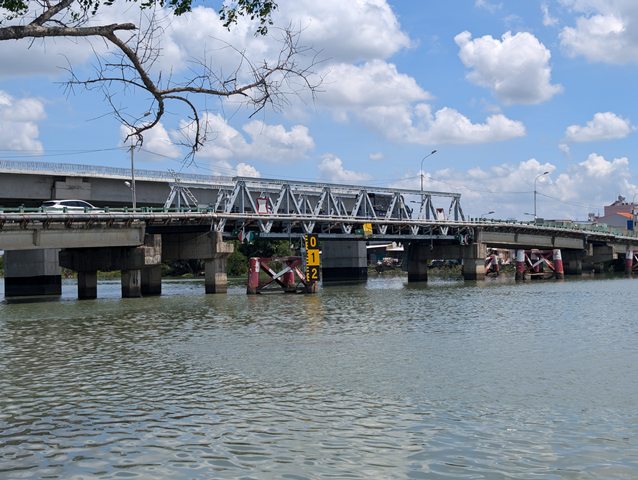
Old Phuoc Long Bridge (Cầu Phước Long Cũ) is a historic steel bridge carrying the former alignment of Pham Huu Lau Road across Rach Dia, also identified in Vietnamese transportation reporting as Rach Phu Xuan. The bridge connects the former District 7 and Nha Be District in the southern portion of Ho Chi Minh City.
The bridge was constructed before 1975, although its exact construction date and builder have not been determined. In November 2024, the Ho Chi Minh City Department of Transport identified Phuoc Long as one of 17 surviving steel bridges constructed before 1975 in the city. This places the bridge among an increasingly diminished group of older steel structures that once played an important role in Saigon's transportation network. The variety of spans including narrow concrete approach spans, wider spans flanking the main span, and the bolted truss (which included riveted battens on its members, making it a rare riveted bridge in Vietnam) suggest portions of the bridge may have been built at different times, or the truss may have been a reused span. Its history is unknown.
During the early 21st century, rapid urban development and increasing traffic volumes made the narrow bridge a serious transportation bottleneck. The bridge carried two-way traffic on a roadway approximately 13–16 feet (4–5 meters) wide, with restrictions on vehicle weight and limited navigational clearance beneath the structure. Traffic congestion was particularly severe during peak hours, with vehicles sometimes required to wait at the approaches before crossing.
Plans for a replacement bridge were approved in 2017, and construction began in 2020. However, the project was delayed for nearly three years because of difficulties acquiring land and relocating affected residents. Construction resumed in 2023 after the necessary land became available.
The replacement Phuoc Long Bridge officially opened to traffic on December 30, 2024. The new reinforced-concrete bridge, constructed immediately alongside the historic crossing, has four traffic lanes and a width of approximately 34 feet (10.5 meters). The overall project had an investment cost of approximately 737 billion Vietnamese dong, including substantial expenditures for property acquisition and relocation.
Despite the opening of the new bridge, the historic steel bridge was not immediately demolished. When photographed on June 9, 2026, the original structure remained standing alongside its replacement, with the older bridge reportedly still accessible to traffic.
The future of the historic bridge remains uncertain. Although the modern replacement has eliminated the need for the narrow crossing to carry major traffic volumes, no confirmed plan for permanent preservation has been identified. Its survival is noteworthy as one of the remaining pre-1975 steel bridges in Ho Chi Minh City, particularly as numerous other historic steel crossings in the region have been demolished following their replacement with modern concrete structures.



Coordinates (Latitude, Longitude):
Search For Additional Bridge Listings:
Additional Maps:
Google Streetview (If Available)
GeoHack (Additional Links and Coordinates)
Apple Maps (Via DuckDuckGo Search)
Apple Maps (Apple devices only)
Android: Open Location In Your Map or GPS App
Flickr Gallery (Find Nearby Photos)
Wikimedia Commons (Find Nearby Photos)
Directions Via Sygic For Android
Directions Via Sygic For iOS and Android Dolphin Browser

© Copyright 2003-2026, HistoricBridges.org. All Rights Reserved. Disclaimer: HistoricBridges.org is a volunteer group of private citizens. HistoricBridges.org is NOT a government agency, does not represent or work with any governmental agencies, nor is it in any way associated with any government agency or any non-profit organization. While we strive for accuracy in our factual content, HistoricBridges.org offers no guarantee of accuracy. Information is provided "as is" without warranty of any kind, either expressed or implied. Information could include technical inaccuracies or errors of omission. Opinions and commentary are the opinions of the respective HistoricBridges.org member who made them and do not necessarily represent the views of anyone else, including any outside photographers whose images may appear on the page in which the commentary appears. HistoricBridges.org does not bear any responsibility for any consequences resulting from the use of this or any other HistoricBridges.org information. Owners and users of bridges have the responsibility of correctly following all applicable laws, rules, and regulations, regardless of any HistoricBridges.org information.
